
MAGNA park HGV Charging Hub
Lutterworth, Leicestershire
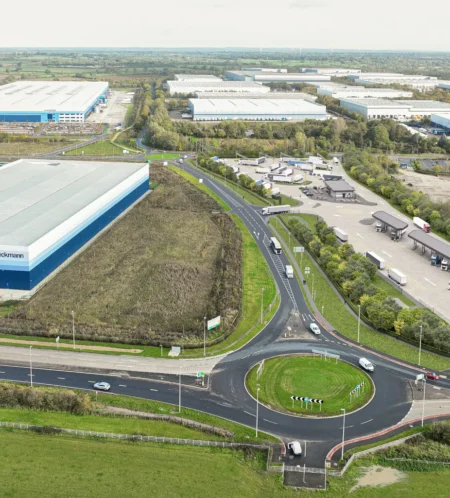
Magna Park is a first-of-its-kind electric HGV charging hub. Set on a 30,000m² site, the scheme will provide 32 chargers, delivering up to 400kW per charge point across 179 HGV bays, supporting the transition to electric freight transport. Serving as a blueprint for future logistics developments, the scheme represents a significant step towards the decarbonisation of the UK’s transport infrastructure.
We were initially engaged by O’Brien Contractors during the tender phase to review value engineering opportunities across the proposed design. By rationalising the drainage strategy, earthworks, pavements and kerbing, we helped develop a more efficient and cost-effective solution that supported the successful award of the contract.
Following contractor appointment, we were retained as lead designer, taking responsibility for civil, structural and geotechnical engineering alongside the coordination of a multidisciplinary team of specialist consultants and subcontractors.
The Challenge
As one of the UK’s first dedicated electric HGV charging hubs, there was no existing base specification against which to design. The scheme required the integration of multiple specialist systems, including charging infrastructure, extensive duct and cable networks, drainage, highways, earthworks and ancillary buildings, all within a rapidly evolving design environment.
Adding further complexity, a high-pressure gas main and high-voltage electrical infrastructure crossed the site, while the facility also needed to achieve stringent security requirements associated with HGV parking and high-value freight. This meant the design had to be developed largely from first principles and tailored to the project’s unique operational requirements, significantly influencing the site layout, access strategy, perimeter treatment and overall design approach.
The project’s pioneering nature also meant that many of the team had limited experience of delivering a comparable scheme, and several had not previously worked together. We played a central role in coordinating these disciplines, managing interfaces across multiple parties and aligning technical requirements to develop a cohesive and fully integrated design solution.
Through early contractor involvement and collaborative design development, we identified several opportunities to improve buildability, reduce cost and minimise construction risk.
Key outcomes included:
- Rationalising the drainage strategy to improve efficiency and reduce construction cost and complexity.
- Reducing the foul pump station depth from 5.1m to 2.41m, significantly lowering excavation requirements while improving installation and maintenance safety.
- Removing more than 1km of bespoke heavy-duty kerbing, reducing both material and installation costs.
- Optimising earthworks, pavement and infrastructure designs to deliver a more cost-effective construction solution.
- Coordinating a wide range of specialist consultants and subcontractors to deliver a fully integrated design package.
By successfully navigating the project’s technical and coordination challenges, Link helped deliver a pioneering scheme that can provide a valuable reference point for future EV charging hubs and industrial developments across the UK.
If you’re facing similar challenges on your next project, get in touch with our experts by calling 0121 716 0100 or emailing mail@linkeng.co.uk. We’d be happy to discuss how we can help.

The scope of works included:
- Design coordination across sub-consultants and contractors (in addition to core technical scope)
- On-site earthworks, drainage, and surfacing design
- Full civils, structural, and geotechnical design lead
- Structural design of ancillary building foundations
Team Member Contact

Nick Moore
Managing Director
MEng (Hons) CEng MICE
Team Member Contact

Gavin Sealey
Associate
BSc (Hons) MSc CEng MICE FGS
Team Member Contact

Valentin Ivanov
Associate
MEng (Hons) CEng MICE
Team Member Contact

Sam Cooper
Senior Civil Engineer
BEng (Hons)
 Share
ShareChatterley Valley
Chatterley Valley Development Site, Stoke-on-Trent


Link were appointed by John F Hunt Regeneration Ltd (JFHR) to undertake the infrastructure design for Harworth’s development site in Stoke. The project scope was to construct the site infrastructure and create a number of development plateau’s in preparation for the future vertical build.
This site has a highly variable topography (falling over 50m along its length) and a number of constraints including shallow mine workings and mineshafts, significant depths of made ground, a public right of way and the West Coast Mainline bordering the site boundary.

Our design included:
- Full 3D modelling of the earthworks (>700,000m3 of cut and fill);
- Geotechnical design and validation including ground treatment by surcharge and monitoring;
- On-site highway and street lighting to adoptable standards (via a Section 7 agreement with Staffordshire County Council)
- Surface water and foul water drainage systems including two large attenuation ponds.
- Liaison with Network Rail (NR) for any necessary precautions, approvals, or modifications in proximity to the railway infrastructure.
- Review of historic coal mining reports and records and design of treatment for shallow workings and a number of mineshaft caps across the site.
Link undertook a number of value engineering exercises to optimise the drainage design and simplify the ground treatment approach, whilst ensuring the end product would satisfy the client performance specification.
Team Member Contact
Gavin Sealey
Associate
BSc (Hons) MSc CEng MICE FGS
Team Member Contact

Neil Shuttleworth
Director
MEng (Hons) CEng MICE
Team Member Contact

Tom Andrews
Principal Engineer
BSc (Hons) MSc (Hons)
Team Member Contact

Karishma Lally
Principal Engineer
MEng (Hons) CEng MICE
Sharesurrey council Depot
Woking Rd, Guildford
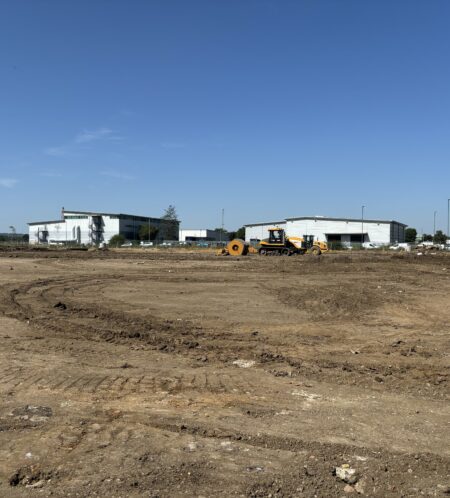

Link supported McLaren through a PCSA with Surrey local authority in order to progress the relocation of their maintenance Depot to release the current depot site for residential development. The new facility will bring together a range of the Council’s departments and services onto one site including: waste services, street scenes,
parks, housing repairs and supporting admin teams.
Link was instructed to undertake the Geotechnical and Geoenvironmental Engineering for the scheme, which was originally progressed solely by AECOM and are now retained by the client. The scheme was taken on at Stage 2 by McLaren.
Link analysed the geotechnical and geoenvironmental constraints, including the adjacent river wey and faul sewer running across the sight, and identified potential risks, such as uplift and differential settlement. Link proposed two alternative options
for the Civil & Structural Engineer to design against: Piled foundations or Controlled Modulus Columns. Either solution was compatible with the overall client requirements and Link’s Remediation Strategy.
Link proposed two options:
Rolling Dynamic Compaction (High Energy Impact Compaction) combined with either piled foundations or Controlled Modulus Columns (CMC). The RDC would work to densify the landfill and induce settlement, thereby reducing the long – term settlement risk and mitigating potential differential settlement within the variable landfill materials. This would have the added benefit of reduced muck away. The choice of piles or CMC was to enable either a piled or traditional spread foundation design based on the client’s preference.
Given the extensive below ground drainage situated below the water table, they chose to pile these against uplift meaning a piling was overall more economical to the scheme. Shallower drainage would have enabled site wide CMC and control settlement of the external yard more tightly leading to lower future maintenance. The foundation costs would also have been reduced.
Enabling Works
Once on site, Mclaren also engaged Link to provide periodic Earthworks support, slope inspections and provide a Design Verification Report for the enabling works phase of the scheme.
During this period of work, Link engineers were on hand to support McLaren with any earthworks issues that may have arisen and resolve queries from the earthworks contractor. A Link Engineer visited site fortnightly to see progress, check testing against the specification and complete required slope inspections.
Upon completion of the enabling works Link produced a Verification Report synthesising the ground improvement and earthworks undertaking and concluding that the works were in accordance with the design and would perform as anticipated.
LINK’S INVOLVEMENT INCLUDES:
- Analysis
– Settlement
– Slope Stability
– Pile capacity analysis
- Ground Improvement Recommendations
- Enabling Works Support:
- Design Verification:
Team Member Contact
Gavin Sealey
Associate
BSc (Hons) MSc CEng MICE FGS
Share